Anyone can create write an article here! Simply make a PR to the
sherbert repo
or ask us on Discord!
Changes usually take effect within ~10min of being approved.
How geometry blends with calculus
by Cyril Ulyanov
22-04-2026
Recently, I came across a mathematical problem from the area of stereometry. I thought it was pretty interesting due to a fairly unexpected way to solve it. Not to give the game away immediately, the core idea is to integrate calculus.
Alright so, here's the information we're given:
In the cube ABCDEFGS, point T is the midpoint of edge FG. Plane α passes through points B, T, and D. Find the distance from point G to plane α if the edge of the cube is 3.
First of all, let's simply draw what we've been provided with:
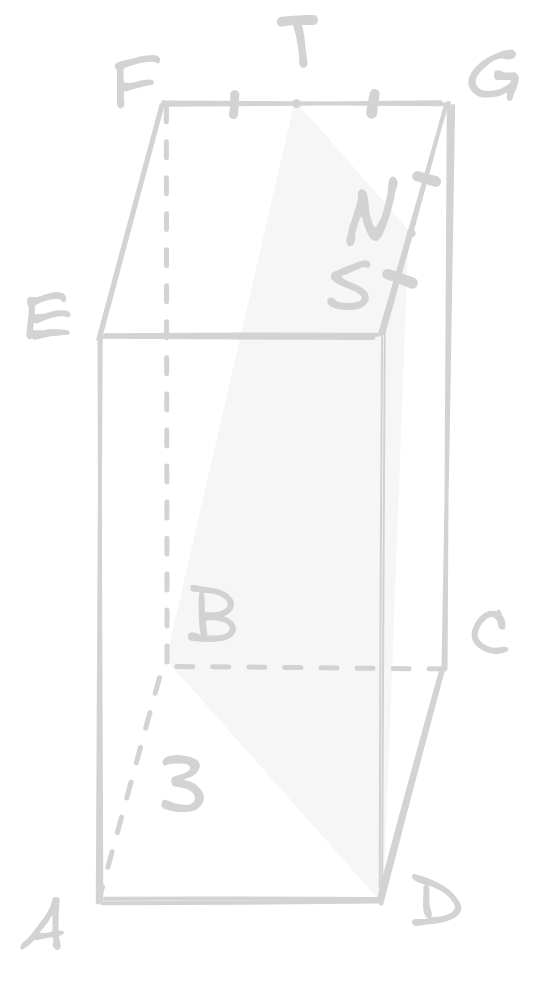
For obvious reasons, section BTND is an isosceles trapezoid. It's more than trivial to prove this fact, but because that isn't what we're here for, simply accept this statement as true. As a consequence, . Oh, and the placement of the section is also quite easy to determine; likewise, we aren't going to concentrate on that.
Let's not forget that a plane is infinite and stretch it further up to cover enough space for the height to emerge.
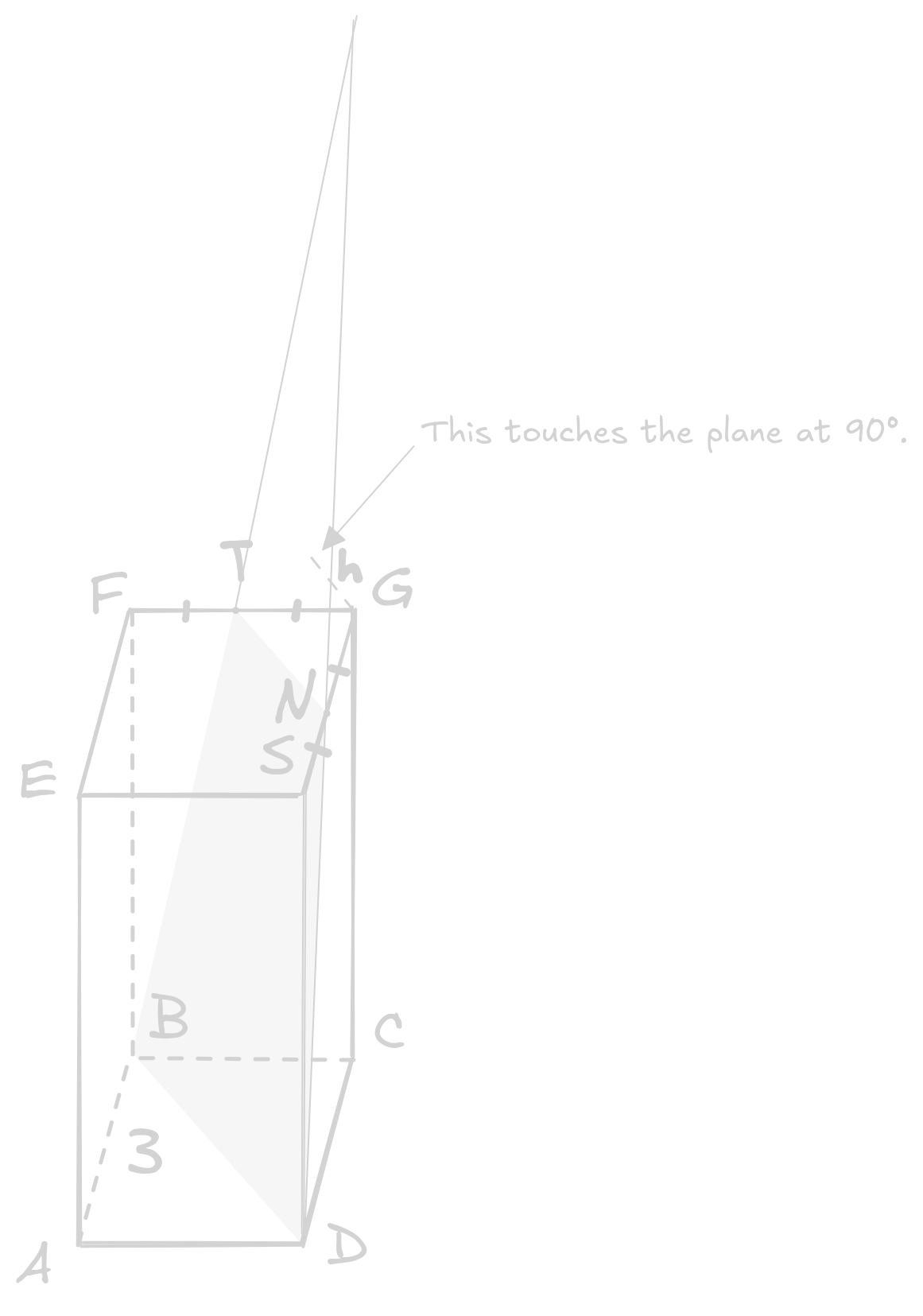
Also, why the heck did I mention the height? Well, what's shorter than a height if we're talking about the distance between and the plane? Nothing.
Let's define a coordinate system where going left increases the , going up increases the , and going forward increases the . All relative to .
Let's describe the plane with the equation and tell it about all the points it contains by simply inserting the coordinates:
Which means:
We're going to need the coordinate we're measuring the height from as well:
With the coordinate of now known, let's find the distance between the point and the plane:
Alright, let's write out the system of equations:
is ignored in the first equation because it cancels out.
Now, let's take a look at the system and notice that what we're looking for is the minimum value of for to actually be the height. Again, the closest distance is the height.
Let's combine the two equations and represent the resulting expression as a function from and .
In order to find the minimum of this function, we're going to leverage partial derivatives.
In a nutshell, the idea is treating as the variable and as the constant and the other way around. When the derivatives of both are 0, it's definitely the minimum and therefore the height, because no other extrema are present, which you can figure out even geometrically.
Solving the system gives:
Now, let's return to and insert the known values to get . Alright, the minimum of occurs at . Because is directly determined by , and , we can get it numerically.
All Articles
- Longest path problem w/ heuristicsby Cyril Ulyanov01-09-2026
- Size does matter, actuallyby Nick Borș27-06-2026
- The most crucial accomplishment of Lev Landauby Cyril Ulyanov04-06-2026
- How geometry blends with calculusby Cyril Ulyanov22-04-2026
- Matrixby Anthony Slab18-02-2026
- Hiatusby Anthony Slab21-11-2025