Anyone can create write an article here! Simply make a PR to the
sherbert repo
or ask us on Discord!
Changes usually take effect within ~10min of being approved.
Size does matter, actually
by Nick Borș
27-06-2026
TL;DR
Make websites the old way — regardless of if you are an individual or not — and respect users time, privacy, and resources. You can check your performance and page weight at Cloudflare's scanning service under the Network tab to see where you stand currently.
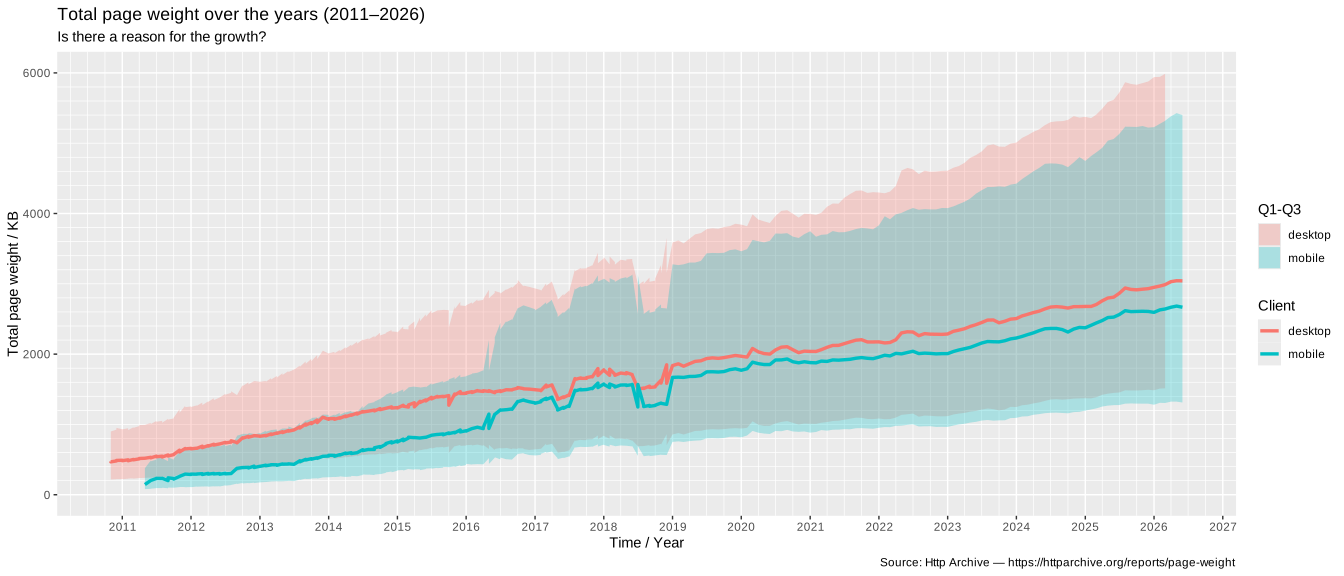
I'd like to start with this graph I made[1]Data accessed on 27th Jul 2026, kindly provided by the Http Archaive (on a lean ~447KB page, which I highly recommend checking out, which just so happens to follow the principles outlined here). Graph was made with R's tidyverse meta-package..
What is it that you notice?
...an upwards trend?
And do you think that it is justified? Has web content really gotten 130x better than it was just 30 years ago to warrant the same increase from ~200KB to a median of ~2.5MB? I think not.
Images, videos, and text, the real content, has gotten both more accessible and more prevalent — a good thing make no mistake — but I find myself feeling disenchanted with the current state of the Internet. Where are our good ol' 88x31px banners? Where is the charm that once was, and where is the craftsmanship that made small efficient websites commonplace?
Today I crawl about the web, encumbered by A.I-generated slop, ads (and A.I-generated ads), upheld by megabytes of unreadable minified JavaScript, veiled in sleek modern UI sanitized of any character, meaning, or memorability. A wolf in sheep's clothing. Though, that's not to say that a subculture of performance-oriented, likely similarly frustrated people don't exist. And its on you whom I call upon to fix this madness.
Static web-pages built upon HTML and CSS offer a simple, streamlined and secure way to interact with the world, share ideas, write articles, research you name it. Even the entrepreneur-developers of the world can learn to thrive through doing things the old way. I think "static" is a bit of a misnomer — you can get a lot done with just a simple HTTP server, a pinch of CSS, and some grit. Notice the lack of JavaScript — it's not as necessary as you think. Web frameworks, optimising for the developer experience have lost my trust. The debt created by their speed and ergonomics is paid for in full by the user in the form of huge payloads. Analytics, tracking, and pop-ups serve to only get in your way, and, upon pealing back the rancid and rampant overgrowth, you will see the reliable brick and mortar of the internet: HTML and CSS. That is where the real content lies. Note, this isn't to say that JavaScript is necessarily bad, but I think that it is a breeding ground to an attitude towards software which disrespects the user. The same can be said for programs outside of the web — as electron apps choose to waste your time, memory, and space for ease of development and promises of cross-compatibility. They do not respect you — or so it seems to me at least — they treat their users as dispensable. If you are to take part in the ever-growing Internet, be wary of following such design trends, and respect your customers and peers alike.
There is this notion floating about that us hackers[2]As defined in RFC-1983 DOI: 10.1787/RFC1983. only care from our own technical point of views, and carry radical philosophy which only makes sense within our social circles. It is not so. The mindset of optimising and unencumbering your users extends to even main-stream, large, transnational corporations, it's rare, but it happens. The impacts of speed, whilst not explicitly clear to the layman, translate into annoyance felt by us all. On the contrary, good leadership and a talented team of developers at McMaster-Carr helped make the minimalist site a staple of modern construction, whilst being about as main-stream as it gets. Open their web-page. I encourage you. Take a look at how fast it loads, and remember this when you are sold the lied to that "websites are just more complex nowadays, so of course their bigger". This catalogue contains thousands of unique products, yet it not only loads quick thanks to clever engineering, but is actually a joy to use. The user experience at McMaster-Carr is a dream of both engineers and UI designers. It is not cluttered. It is not difficult to use like other commercial catalogues such as eBay or Amazon with their endless nested drop-downs and inept search functions (if you have used eBay, I'm sure you know what i mean).
But how could such a minimalist, function-over-form attitude ever promulgate in the corporate world? Don't shareholders chase sleek, modern design and don't product managers demand they look better than their competitors?
Yes, they typically do don't they? I think that's bad leadership bandwagoning on the promise of dividends for investors through the use of modern bloat painted in the lead paint that is modern UI trends. The truth is that this mentality is in a false dichotomy with the demands of the business world. In reality, users will come back time and time again when something is boring and "just works". If you are in a leadership position, try to see this case study as an opportunity to be inspired. If you are a regular non-technical user, admire the ordinary and stop and smell the roses. And lastly, and most likely, if you are a developer, be inspired by the masterful showcase of techniques which dance backstage behind the boring old website:
Image atlases to reduce network requests. They just send one strip
Images with fixed widths — no expensive DOM redraws. This website skips every re-layout it can.
Inlining critical CSS to prevent layout shifts.
Pages are pre-loaded when you hover over links so they're ready for when you click. The use of assumptions and heuristics to improve UX at the expense of their server workload sounds to me like the antithesis of Big. Bloat. Notice how they respect your time, and value it over their computational resources?
Client-side caching via service workers — they (literally) stop you from making unnecessary requests.
JavaScript bundling. Though they admittedly use a lot, they are careful enough to only include what is used on a per-page basis.
...and many more I probably haven't yet discovered.
My point being, it is not only viable but beneficial[3]This claim is corroborated by Web.dev's Why speed matters and Ikášová, Tereza & Klepek, Martin. (2024). The impact of website performance on business sales. Financial Internet Quarterly. 20. 81-91. DOI: 10.2478/fiqf-2024-0007 and others you can easily find. This is just what I read. to be speedy, and understandable (with studies reporting 8% and 10% increase in conversion rates, and order value growing by 9.2% and 1.9% from a mere 0.1s difference in load times for retail and travel sites respectively[4]Deloitte's Milliseconds make Millions PDF). That's what retains users — not pestering them with useless AI chatbots and banners that seem to always block your clicks, returning time and time again after your dismissal.
As for individuals (hopefully such as yourself) allied to the fight against bloat, there too exists a space carved out on the internet. I'm not referring to your popular chat platforms, such as Discord, Telegram, and X (formerly Twitter), of course. They are subject to the whims of politics, legislation, bankruptcy and serve only to sell your (meta) data away to the highest bidder — literally. No, I mean web-rings, IRC, XMPP, mailing lists and other little nerdy and geeky communities (such as this one!). Mass media makes you the product. Strive to dominate the surrounding technologies, own them if you can, lest they dominate you. Governments are getting more and more comfortable in taking away your liberties (at least in some parts of the world) and whether or not you believe that, or whether it applies to where you live, it should still be important to you to keep, practice, and maintain your rights. This is yet another way in which the modern web disrespects you, the individual. So if you needed a sign to join these little unknown communities hidden from the public eye, maybe this is it (consider nh3.dev?).
Anyways, enough rambling.
Cool further reading/practical advice
Page weight based clubs (self explanatory):
The No-JS club (self explanatory).
Danluu's post on web-bloat is about web-bloat focusing on connection speeds.
This triad. You can open, and steal their ideas/css/attitude as you see fit:
Contrast Rebellion's article about contrast which embodies a wider premise of function over form.
This site dedicated to System font-stacks; they should be preferred almost always (imo).
All Articles
- Longest path problem w/ heuristicsby Cyril Ulyanov01-09-2026
- Size does matter, actuallyby Nick Borș27-06-2026
- The most crucial accomplishment of Lev Landauby Cyril Ulyanov04-06-2026
- How geometry blends with calculusby Cyril Ulyanov22-04-2026
- Matrixby Anthony Slab18-02-2026
- Hiatusby Anthony Slab21-11-2025